
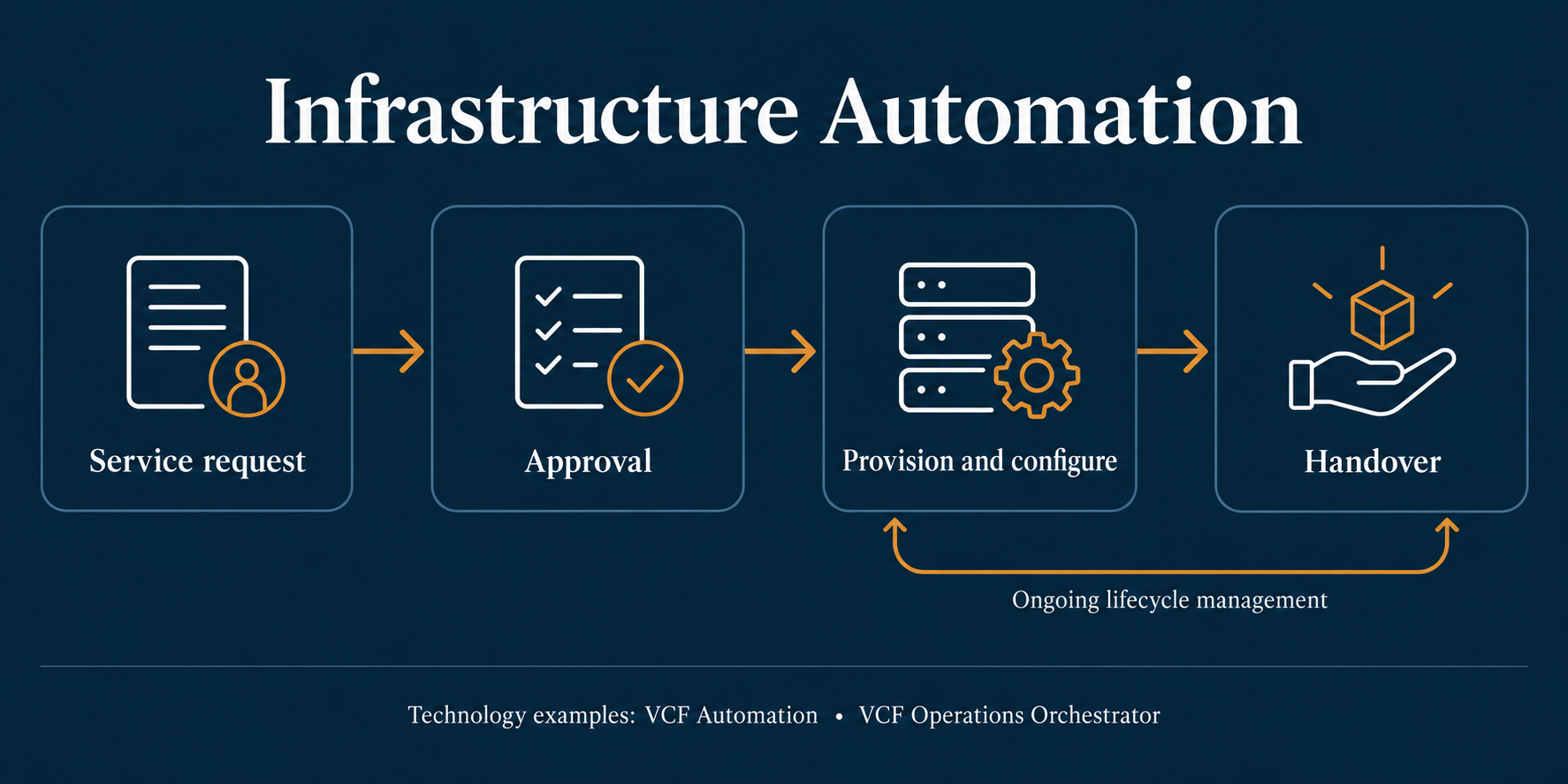
An infrastructure request can pass through several people and systems before it becomes a usable service. Teams may need to confirm requirements, obtain approval, allocate resources, configure the environment, and communicate the handover. When each request depends on separate manual actions, delays and inconsistent outcomes become harder to manage.
Infrastructure automation and orchestration help turn repeatable activities into defined services. Users receive a clearer way to request what they need, while IT teams establish the available options, approval requirements, and standards that govern delivery.
Give users a clear path to a service
A self-service catalog presents approved services in terms users can understand. A requester selects an appropriate option and supplies the required information. The organization can then apply the relevant approval and provisioning process rather than repeatedly clarifying the same basic requirements through email.
Standardization is important here. A defined service needs clear inputs, an accountable owner, and an agreed description of what successful delivery includes. The catalog becomes useful when the service behind it is predictable and its boundaries are understood.
Connect the work across systems
Automation performs repeatable tasks. Orchestration coordinates those tasks, their dependencies, and interactions across systems. Together, they can support the journey from an approved request to an environment that is ready for handover.
For example, a workflow may need to coordinate resource provisioning, configuration, and updates to operational records. If a required step fails or needs an exception, the responsible team needs visibility and a clear path to resolve it. The process should make both successful delivery and unresolved work understandable.
An illustrative scenario
An application team requests a standard test environment. The requester selects an approved service, provides the required details, and submits the request. Once the appropriate approval is obtained, the defined provisioning and configuration activities run. The team receives the handover information when the required checks are complete.
Later, a resource adjustment or retirement request can follow an agreed lifecycle process. This helps keep ongoing changes connected to ownership and operational standards instead of treating the initial deployment as the end of the service.
Start with a repeatable service
A practical starting point is a frequently requested service with well-understood requirements. Teams can document its current process, identify recurring handoffs, and agree how to assess the outcome. Relevant measures might include request turnaround, manual interventions, failed steps, and the completeness of handover information. Improvements should be measured in the customer’s environment rather than assumed.
Technology example
Bconnect delivers infrastructure automation and orchestration using VMware Cloud Foundation Automation and VCF Operations Orchestrator, alongside earlier VMware Aria and vRealize environments. These capabilities support self-service provisioning, approval workflows, and coordinated infrastructure operations. The product generation and implementation scope are aligned with the customer’s environment.
Discuss your infrastructure workflows with Bconnect
Contact Bconnect to identify a suitable service for automation and explore how governed self-service could support your operational priorities.
Discuss this capability with Bconnect →