
Legal teams work with documents whose meaning depends on precise language and context. Reviewing contracts, comparing versions, locating clauses, and consulting internal guidance all require attention. The volume of material can make document preparation and navigation a demanding part of the work before a reviewer reaches the questions that need professional judgment.
AI assistance can support these document-intensive activities by helping reviewers find relevant passages, prepare draft summaries, and organize points for examination. Its value is in supporting a professional’s work with the material, while interpretation, advice, negotiation, and approval remain with the legal team.
Making review points easier to examine
A useful review aid connects an observation to the wording that prompted it. This allows the reviewer to inspect the surrounding text, consider definitions and related clauses, and decide whether the observation matters in context.
Potential applications include locating clauses on a specified subject, summarizing stated obligations, comparing supplied document versions, and highlighting potential differences from an approved internal playbook. These outputs provide starting points for examination. They should not be presented as a complete legal assessment or a guarantee that every issue has been identified.
An illustrative scenario
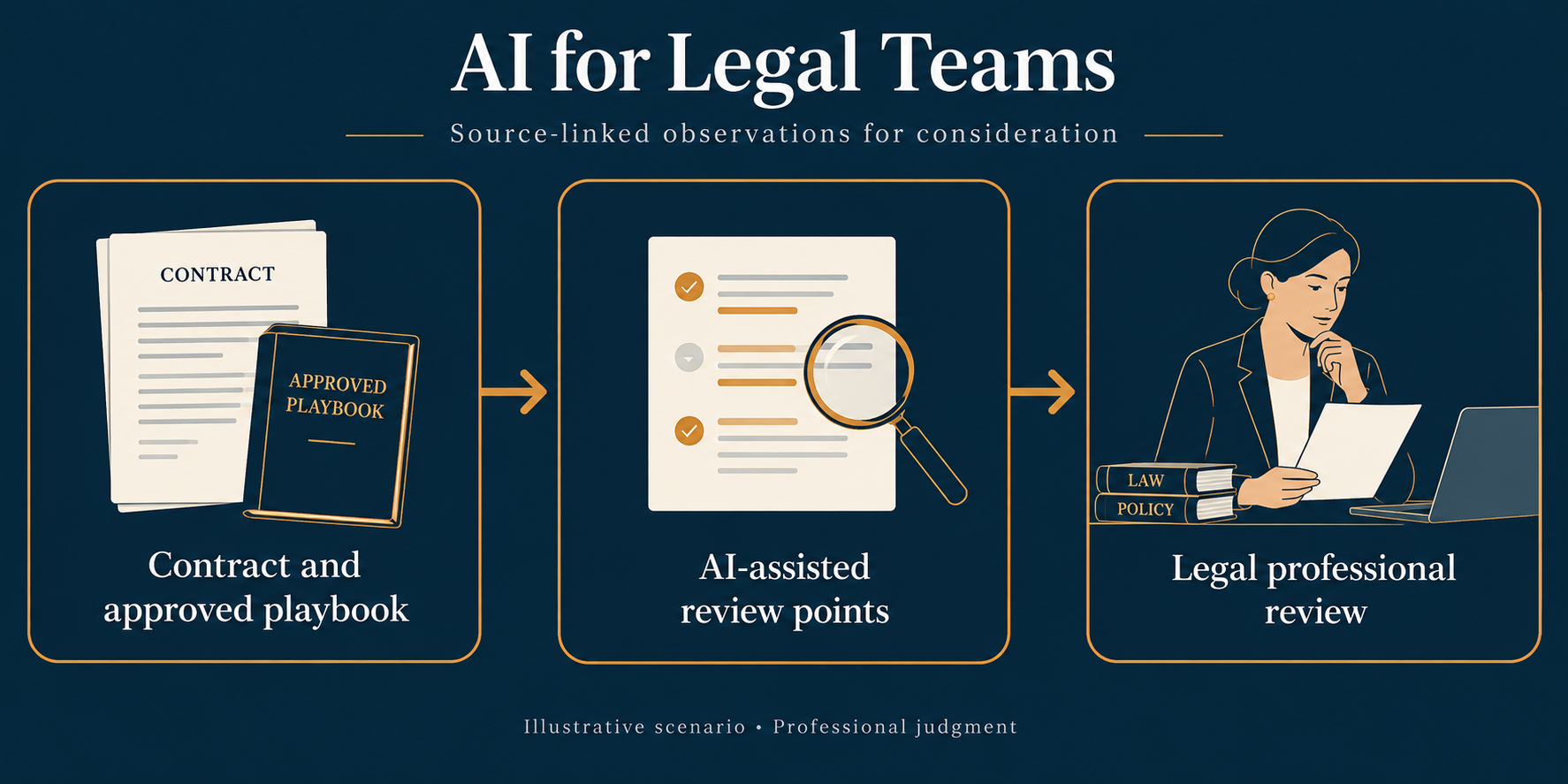
A legal professional reviews a fictional supplier agreement against an approved company playbook. The reviewer asks for passages relating to renewal, termination, and stated responsibilities, together with potential differences from the supplied guidance.
The assistant returns draft review points linked to the relevant passages. The professional checks the wording in full context, dismisses observations that are not applicable, and records any questions or proposed changes that require further discussion. The legal team retains control over the significance of each issue and the next action.
Supporting careful use of information
Confidentiality and access requirements are central to the discussion of any legal document capability. The scope of information available to a user should reflect their authorization, and reviewers should be able to check the source material behind an output.
For teams working with Arabic and English documents, assistance can help navigate material across languages. Where the exact wording has legal significance, the original text and professional interpretation remain essential. Any incomplete, ambiguous, or conflicting information needs to remain visible throughout the review.
Bconnect works with organizations to explore AI assistance for legal teams around clearly defined document tasks and reviewer needs. Public demonstrations can use fictional agreements so the experience can be assessed without exposing client documents or internal methods.
Explore AI assistance for your legal team
Contact Bconnect for a private demonstration and discuss the document activities where your team would benefit from additional support.
Discuss this capability with Bconnect →